Pinot noir and old French toilets – what’s not to love?
1. PDF – just for when the link is no more…
2. Link to study
in case you missed it
A great story – 1899 RC !!
And with so many nameworthy tasters to appreciate the bottle too.
Of course, there are so many unanswered questions, my first of which is ‘How did the date survive so legibly intact, and precious little of the rest of the label(s)?’
My spider-senses are heightened after seeing so many wines at auction that just miss a (vintage) digit and are purported to be, for instance, a 1945 when they could just so easily be a 1944 – there’s quite a difference when it comes to DRC!
And wasn’t that an amazing fill? I’ve seen much worse on (still tasty!) wines from the 1950s. The wines from the 1860s in Bouchard Père’s cellars are in much better condition, but they are also topped up and recorked roughly every 30 years!!
But that’s enough of the cynic in me. So long as everyone was happy 🙂
New rules for old vines?
New rules for ‘old vines?’
There are no rules for labels – everybody says it, everybody knows it – though everyone still used the label. But, eventually changes are planned.
Not everyone was consulted from the start – which caused some ruffling of feathers at the INAO and in the Languedoc – but it seams that the limit for labeling your wine ‘VV’ will be set at 35 years. But it’s France, so will there be more consultations planned? And is it legally binding? Your guesses are as good as mine, but the current info is that 35 is the number
It’s not ideal, and whether it’s the right (best?) age also depends on the grape-variety. It will also pose questions for many labels of long standing – Musigny Vieilles-Vignes, anybody?
But finally, it may come to fruition !!
Vosne-Romanée – the 2024 boundary changes …
Right: Romanée-Conti 28 April 2025
A few weeks ago, I read an article that stated ‘it appears the Vosne-Romanée appellation zone has been expanded, incorporating an additional 30 parcels of vineyard into the appellation. In total, these blocks constitute three hectares (7.4 acres).‘
Seemingly, this was a story that had slipped through the net but it was hard to get to the bottom of what was involved. I had to enlist the help of ‘Burgundy Wines,’ to get to the information – and it took them some time too, despite that I was not the only one asking for clarification.
It seems that the actual situation is much more modest than the quote (above) might suggest. I’ve slightly modified the words of their researches, only to make the situation a little more concise:
Whilst the number of ‘modified’ plots is indeed notable — around thirty in total — the actual changes involve only very small areas, often no more than a few rows of vines.
This is part of a broader clean-up of the appellation boundaries which, for Vosne-Romanée, was completed at the end of 2024.
The changes were brought about using a ‘simplified mechanism’ that allows for minor adjustments without triggering a national ‘opposition process.’
Other appellations have already used, or are in the process of using, this same mechanism. These updates typically occur every 10, 15, or 20 years to reflect the evolving realities on the ground.
Four Premier Cru Climats are included in these adjustments:
1. In Vosne-Romanée:
Aux Brûlées is now 4.6311 ha from 4.5408 ha
Aux Raignots/Reignots is now 1.6422 ha from 1.6295 ha
Les Petits Monts is now 3.7283 ha from 3.6803 ha
2. In Flagey-Echezeaux:
Les Beaux Monts is now 7.5628 ha from 7.0589 ha – the largest change
The 4.4514 ha of Beaux Monts in Vosne-Romanée is unchanged
I’ve known for some time that some producers with vines in Beaux Monts have not been declaring part of their production as 1er cru – this should change in 2025. And to underline, there have been no changes made to the boundaries of the Grand Crus.
Hospices de Nuits St.Georges – their 63rd wine auction – the 2023s
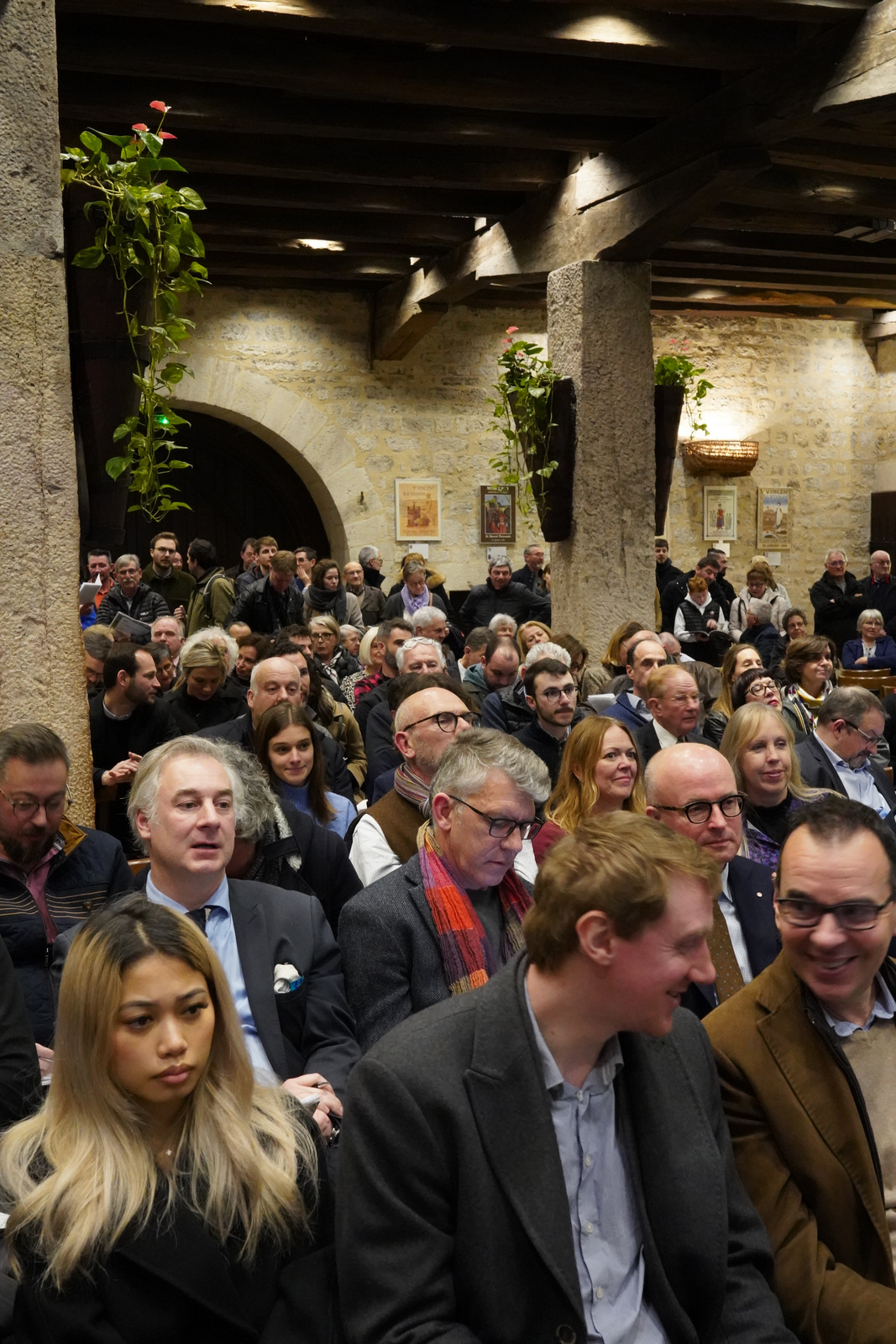
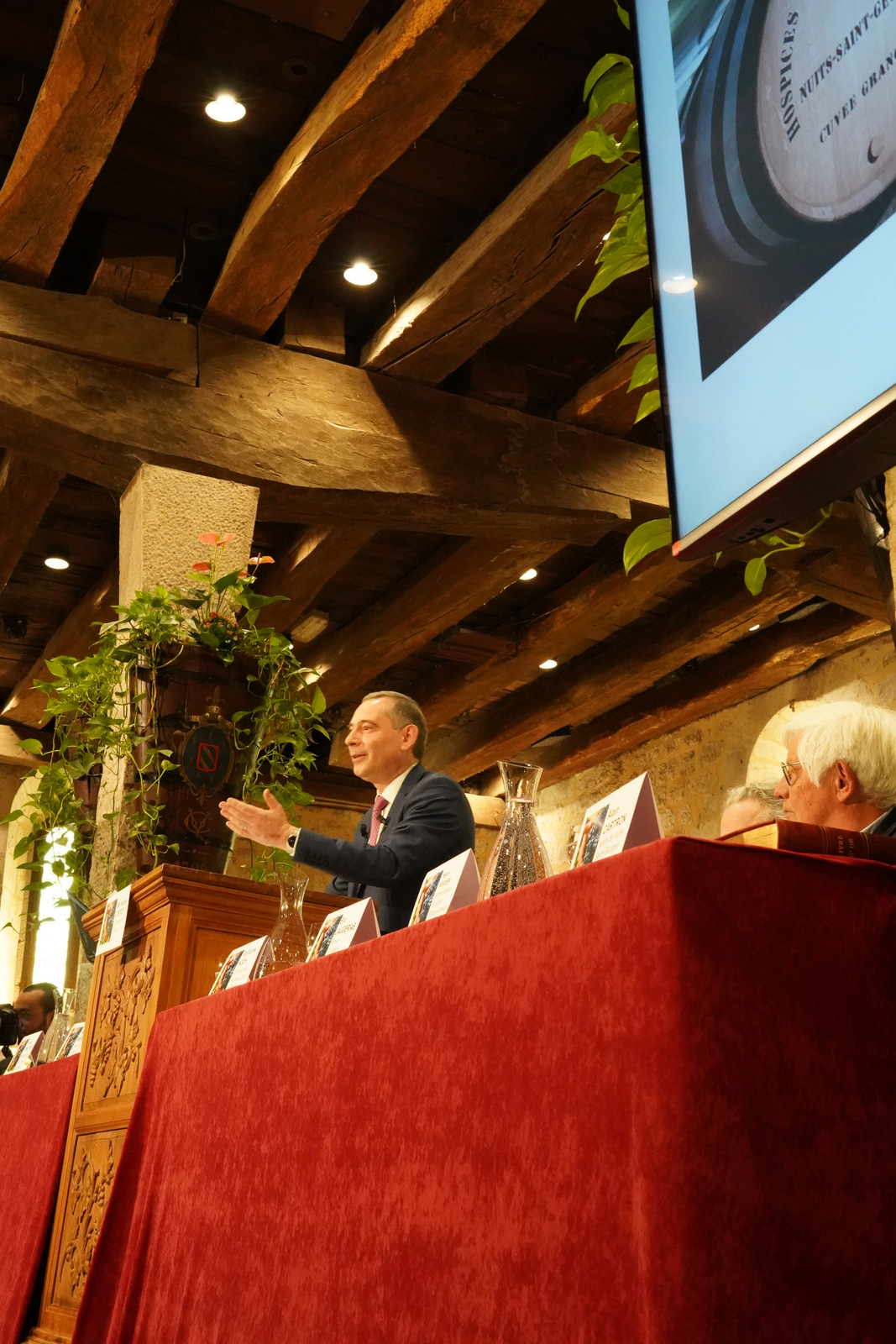
Yesterday, Sunday 10th March, for the first time since the auction moved to the Clos de Vougeot, I went along to the wine auction of the Domaine of the Hospices de Nuits.
Sales prices were a little down – but that’s the global market. By the end of the sale, the organisers could make some nice quotes and all the wines were sold – it was a good total for the organisation and the local charities linked to the sale – so well done for them.
The first lots were three barrels of 1er Les Murgers – one of the smallest cuvées of the Hospices – €20,000, then €21,000, the €18,000 were the winning bids – the latter a possible bargain for Domaine Henri Gouges. The villages wine that followed started at €10k slowly dropping to 8.5k then further to 8k – but this buyer took 4 barrels! For the next barrels of villages there was some discussion as there were no takers at the starting price of 7k – eventually the bid was ‘won’ at 6k but they – it was Bichot – took 5 barrels. Another winning bid of 6k came – this time the buyer taking 4 barrels – Boisset in this case.
The following lots brought the return to 1er crus and the next lot of Porrets St.Georges made 16k. The buyers were present but, it seemed, reticent – and so it continued.
The final result registered a total of 2,281,500 Euros, this was the third highest in the history of the Hospices de Nuits St.Georges – though behind that total was quite the large number of barrels in this vintage which masked a little the effect of lower prices.
The Pièce de Charité, known as the “Cuvée des Bienfaiteurs”, did indeed achieve a new record bid of €68,330 for the benefit of the Clément-Drevon Foundation – a medical research organisation. Also setting a new record was (in only it’s second appearance!) the Cuvée Hugues Perdrizet Nuits St.Georges 1er Cru Les St.Georges Vieilles Vignes which attained a winning bid of €60,000.
I remain convinced that the way forward for maximum returns for the Domaine of the Hospices de Nuits wines will be best developed if brought together in same sale as that of the Domaine of the Hospices de Beaune – it would be a win-win, I’m sure. But today, this is what we have…
ICYMI: The quercetin culprit – red-wine headaches ‘explained’
So that’s what it’s called – I had always assumed that it was just the physical side-effect of opening that 5th bottle…
ICYMI – Les Maladières…
In this case, Beaune – but what better representation of a Leproserie than the magnificent building on the outskirts of Meursault. Next time that you eat at Le Soufflot or Goutte d’Or – take 10 minutes to walk around this splendid relic of a building.
- The Maladière de Beaune: “In the shadow of the Grand Hostel Dieu, many other hospitals existed in Beaune. One of the most important was the Maladière, an institution in charge of one of the most feared diseases of ancient times: leprosy.“
Featured Image courtesy the archives of Beaune
ICYMI
A small compendium of interesting notes form the last couple of weeks:
- “The generous 2022 vintage (around 1.75 million hectolitres, or just over 233 million bottles) has enabled some stocks to be replenished and/or orders to be met pending availability. Export sales continue to grow. Export volumes are down slightly, after a good year in 2022, but remain higher than in the pre-Covid period (2019): +5.3% in volume (first 6 months of 2023 / first 6 months of 2019).”
BIVB Press Conference 10 Oct.2023 - “Within 3 months, nearly 33,000 visitors have passed through the doors of at least one of our 3 sites. Beaune boasts more of 70% of visitors, with a total of 5,000 all told; Chablis and Mâcon attracted around 4,000 visitors each. A large majority of visitors – a full 80% – were from our region or elsewhere in France; and of the 20% of visitors from abroad, a majority came from either Belgium or Germany. The busiest days, apart from the inaugural weekend, were on the long weekend of 15th August and the European Heritage Days weekend in mid-September.”
Also the BIVB Press Conference 10 Oct.2023 - A short ‘interview‘ with Sylvie Esmonin
- London’s Bourgogne Week will be held on January 10 at Lindley Hall. “The focus will be on the lesser-known Regional and Village appellations, an important theme that addresses customer demand” – apparently the grand crus no-longer are interesting 😉
- A new video covering Viré-Clessé
Another ICYMI – high priced wine-ethics

This is a tough one, isn’t it?
- Can you ethically drink Romanée-Conti?
I always review wines in the same way – is this a great Bourgogne? Or is this a great grand cru? I never tell you that a particular wine is worth a special search unless it is on another level to ‘the average’ – even ‘excellent’ doesn’t cut it! Despite that, over the last few years, the cuvée of Romanée-Conti has consistently got my thumbs up – even at the latest price. From memory, the 2020 was close to €3,000 a bottle – assuming you were allowed to buy even a single bottle from one of the official importers.
The (grey) market price for that bottle is already 4-5 times the initial purchase price – and who knows the price in a restaurant! Because 500 cases for the whole world are clearly insufficient to meet the clamour to buy.
In a different life, I have bought and drunk Romanée-Conti, I think the 2000 vintage cost me only 800 Swiss francs or roughly €500 at the time – but my earnings allowed me to do this. Today, even the entry price is beyond my personally imposed buying limit – but, given my age and the ‘above average’ size of my cellar, the volume of my personal purchasing has shrunk to such an extent that I’m, anyway, no longer on the list of ‘allowed’ buyers.
Now we come to the use of the word ‘ethics.‘
When I recommend wines, it is done so purely with quality in mind. Simply put, that’s because everybody’s concept of value is different – you cannot have a benchmark yes/no ‘value’ for wine for people of different backgrounds – even when a bottle may cost more than most people pay for a car! Ethics is a barbed word and it implies yes/no or black/white – and life is not a binary choice. Describing drinking Romanée-Conti as unethical would suggest that the search for the best (in any walk of life) should be cancelled. So what then of the vineyard? Should it be uprooted? If so, does that mean that Musigny or La Tâche would be next? The logical extension of this would be that Burgundy should blend everything and only produce Côteaux Bourguignone…
The search for the best in any endeavour is costly, be that cars, watches, HiFi, computers Hermes bags – you name it – and yes, wine. In all things, it is about personal choice. I have my own – personal – rules but ethics is an unhelpful word – it is one to avoid…