Warning – Opinion!

A great story – 1899 RC !!

By billn on February 07, 2026 #degustation#in case you missed it#warning - opinion!

CNN-1899-RCWell – it’s a great story !!

And with so many nameworthy tasters to appreciate the bottle too.

Of course, there are so many unanswered questions, my first of which is ‘How did the date survive so legibly intact, and precious little of the rest of the label(s)?’

My spider-senses are heightened after seeing so many wines at auction that just miss a (vintage) digit and are purported to be, for instance, a 1945 when they could just so easily be a 1944 – there’s quite a difference when it comes to DRC!

And wasn’t that an amazing fill? I’ve seen much worse on (still tasty!) wines from the 1950s. The wines from the 1860s in Bouchard Père’s cellars are in much better condition, but they are also topped up and recorked roughly every 30 years!!

But that’s enough of the cynic in me. So long as everyone was happy 🙂

New rules for old vines?

By billn on February 05, 2026 #in case you missed it#warning - opinion!

Old vines - FolatièresNew rules for ‘old vines?’

There are no rules for labels – everybody says it, everybody knows it – though everyone still used the label. But, eventually changes are planned.

Not everyone was consulted from the start – which caused some ruffling of feathers at the INAO and in the Languedoc – but it seams that the limit for labeling your wine ‘VV’ will be set at 35 years. But it’s France, so will there be more consultations planned? And is it legally binding? Your guesses are as good as mine, but the current info is that 35 is the number

It’s not ideal, and whether it’s the right (best?) age also depends on the grape-variety. It will also pose questions for many labels of long standing – Musigny Vieilles-Vignes, anybody?

But finally, it may come to fruition !!

‘Glassware’ – a little fun…

By billn on November 21, 2024 #degustation#warning - opinion!

Grassl & SydoniosRight: Grassl & Sydonios (or Sy)

Last week whilst tasting some very nice Clos de Tart, winemaker Alessandro Noli asked me if I’d like to compare two different glasses. I was up for that – it also turned out to be a fascinating experience!!

Our tasting used the ‘traditional’ Sydonios Esthète glass as in multiple previous tastings here. But for a couple of wines, we compared our first impressions, made with that smaller Sy, with the larger bowled Grassl offering – and my takeaways were:

Wine #1 now with the Grassl
Of course, a larger nose now fills this larger bowl – but the effect is more airy and it’s also less easy to find the precisions. The wine on the palate seems more direct and fluid – the tannin softer/less evident – still great but it doesn’t really seem like the same wine – hardly!

Wine #2 now with the Grassl
A less concentrated but larger nose – here some spiciness not seen in the small glass. Supple, almost fluid again – a wine that melts more over the palate – I think more accessible too, and again partly due to more softness to the tannic structure. And, yes, a similar finishing shape, intensity and flavour to the smaller glass – except that the amplitude seems dialled down, it’s less intense but still ultra-long. Dumbed down? That would be unfair – but made a little easier!

If you have to make a choice – large-scale, important reds will seem more accessible as the texture of the tannin seems silkier – so maybe good for the table. Personally, I preferred the more visceral, full-volume performance of the smaller bowled Sydonios. The wine when served in this glass will be, for sure, stricter. But you know that I like strict 😉

Anyway, I want full volume when I’m tasting wines…

Rolling around in the gutter… (?)

By billn on September 12, 2024 #a bit of science#warning - opinion!

I’m indebted to my good friend Jean-François Guyard to alerting me to this and I think it’s a sober reminder to always be circumspect about who is telling you what, and why !!

In recent months, we have spoken here several times about the increasing negative mood in society and politics towards alcohol and wine consumption. There is now new, concrete evidence on this.

As the magazine wein.plus reports, the recommendation of the World Health Organization (WHO) to avoid alcohol is based on studies whose authors are controversial. The two Canadian scientists Dr. Tim Stockwell and Dr. Tim Naimi, who advise the WHO , are demonstrably close to the organization Movendi International. Since 2012, this name has been used to refer to the Good Templar Order, which wein.plus characterizes as “an abstinence and temperance organization that campaigns against alcohol consumption and promotes an alcohol-free lifestyle” and Founded in the USA in 1851, Movendi International is now the leading global network for development through alcohol prevention. The organization is an official partner of the WHO and the United Nations.

“Many scientists reject […] Stockwell and Naimi’s motives and approaches. They criticize the two as protagonists of a worldwide abstinence movement that has been working for years to banish alcohol from society worldwide,” writes wein.plus. The accusations were also directed against the investigation and publication methods of the two gentlemen. Wein.plus quotes the British journalist Christopher Snowdon: “Stockwell’s approach to alcohol issues is refreshingly simple. If he wants something to be true, he says it is true – regardless of whether what the evidence says.”

British statistician Sir David Spiegelhalter from the University of Cambridge also supports this view. He told The Drinks Business magazine that statistically the overall risk of drinking a glass of wine a day to life expectancy is no greater than that of driving a car or eating bacon. Research confirms the health benefits of moderate alcohol consumption. “It annoys me when the harms of small amounts are exaggerated, especially with statements like ‘no level of alcohol is safe’,” Spiegelhalter told The Drinks Business.

When it comes to scientific studies, it is always worth questioning the publishers and their interests in order to avoid falling victim to zealots or lobbyists. This applies equally to both pro and con alcohol.

Thanks Jean-François…

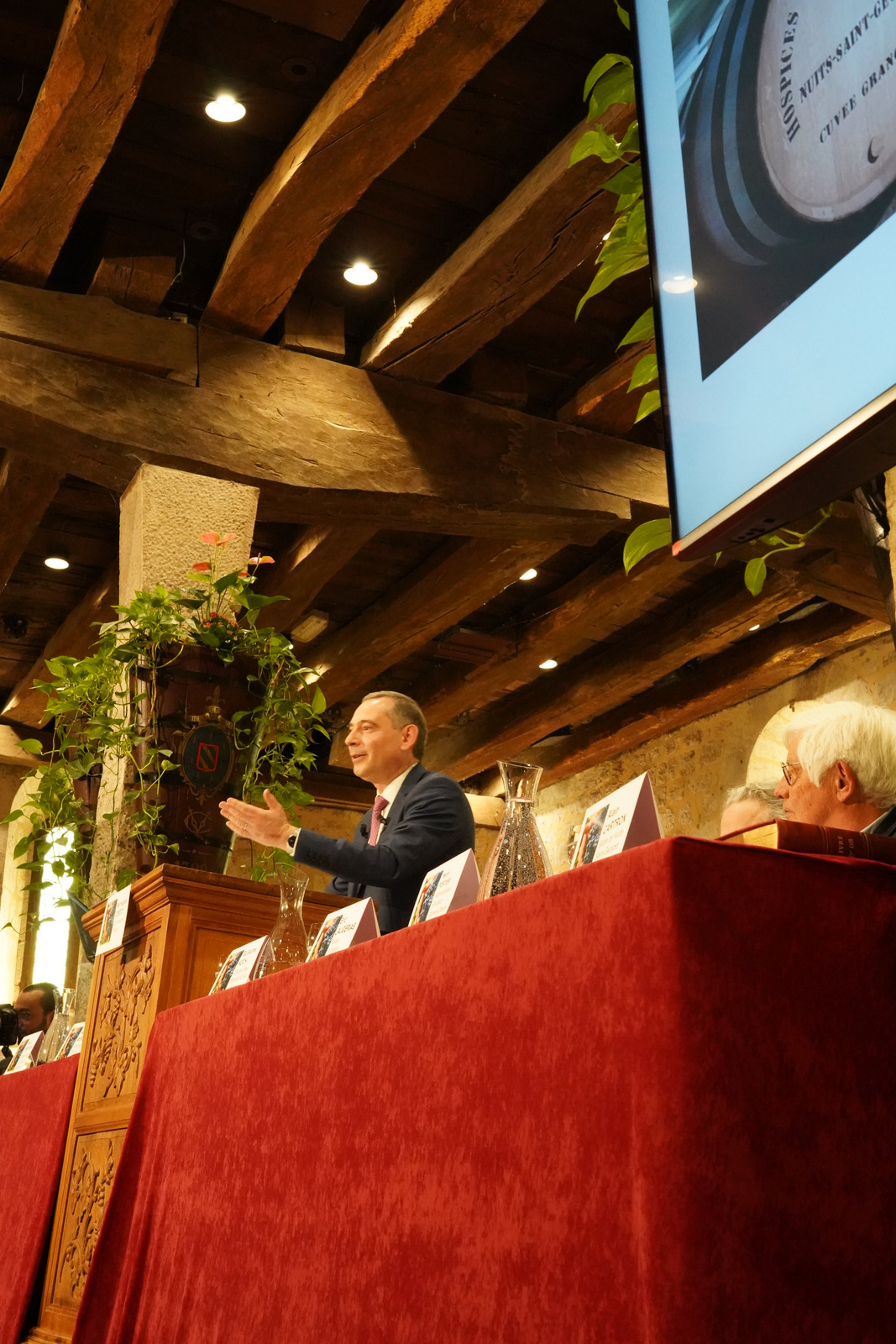
Hospices de Nuits St.Georges – their 63rd wine auction – the 2023s

By billn on March 11, 2024 #events#in case you missed it#warning - opinion!

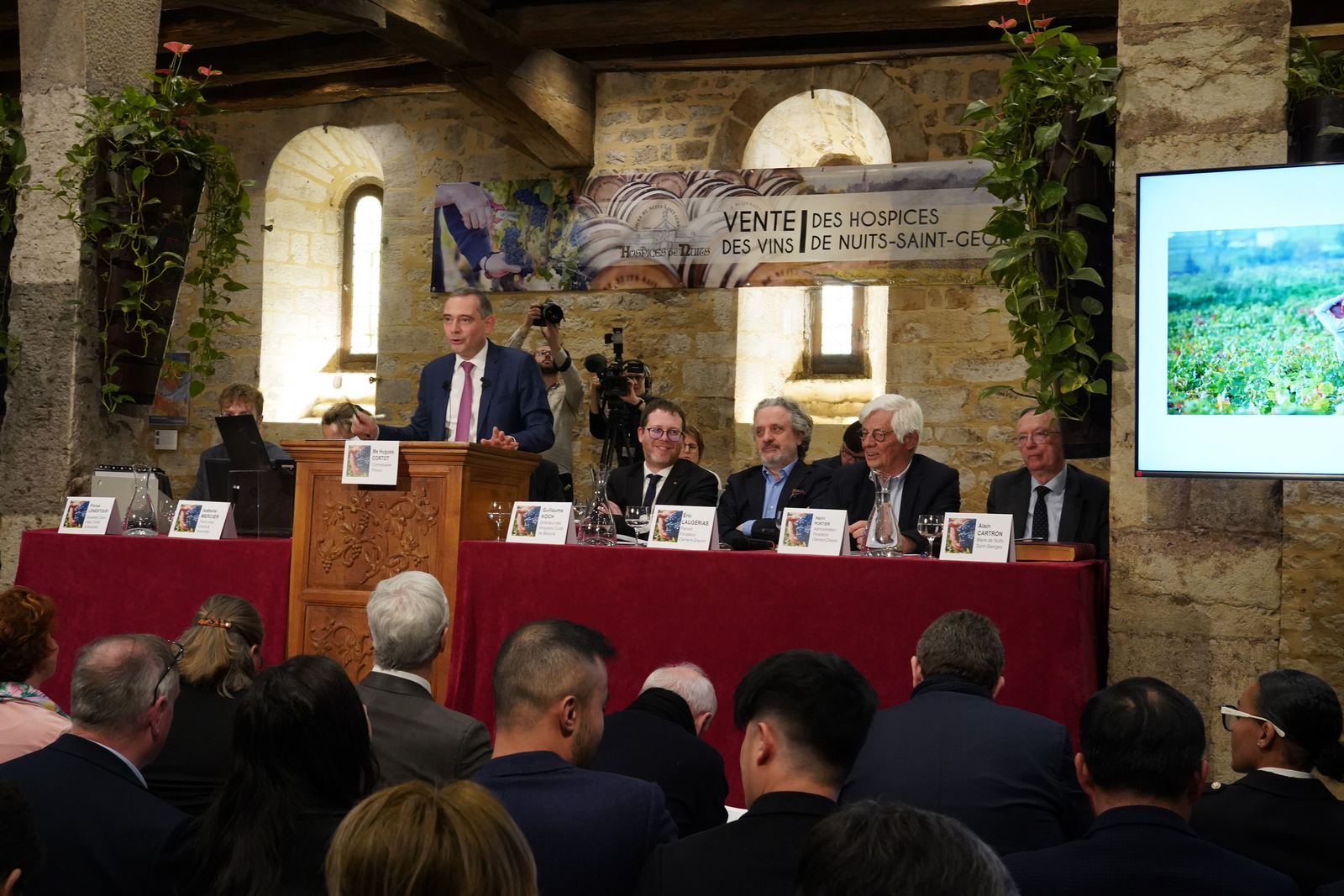
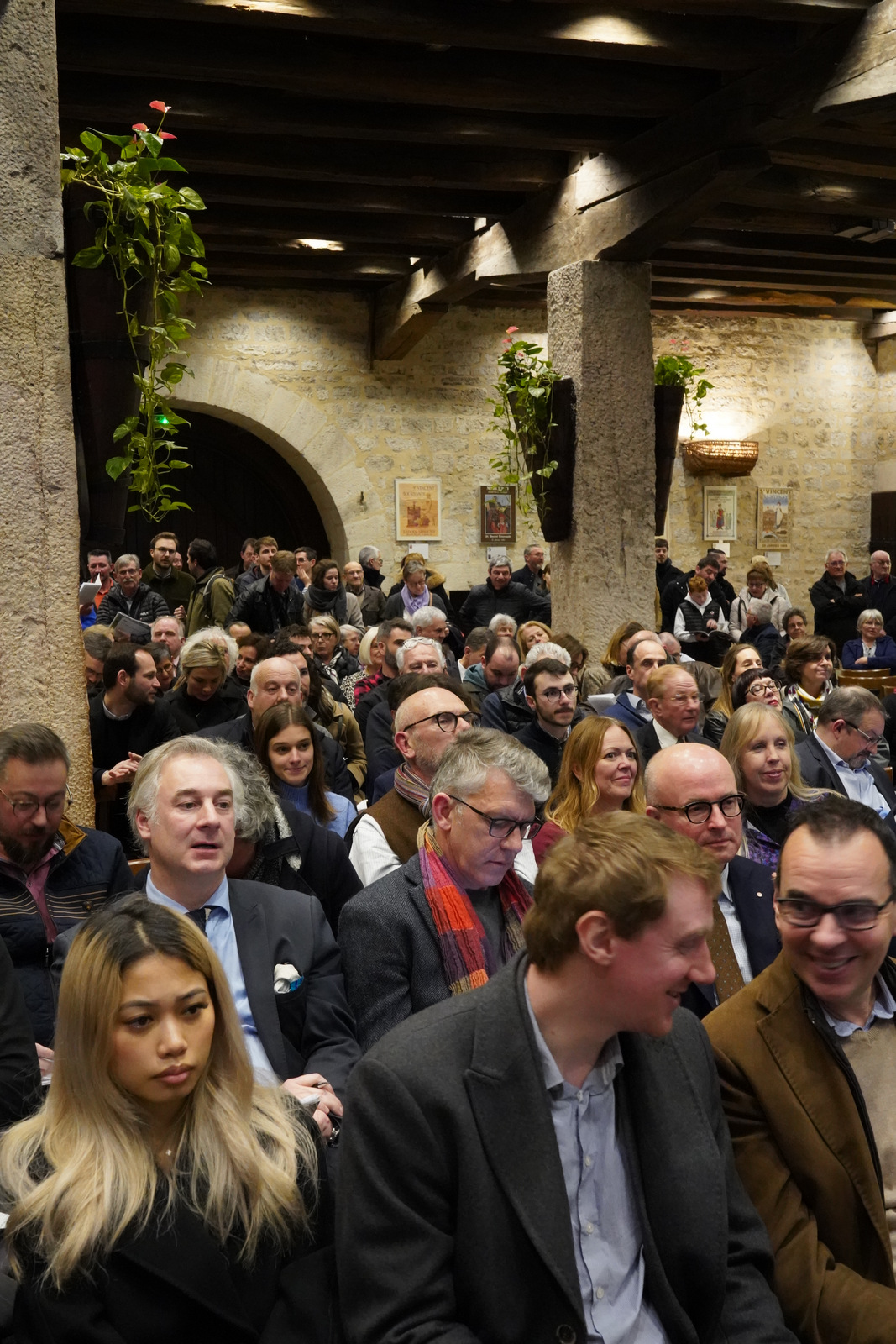
Images Sunday 10th March – in the Clos de Vougeot

Yesterday, Sunday 10th March, for the first time since the auction moved to the Clos de Vougeot, I went along to the wine auction of the Domaine of the Hospices de Nuits.

Sales prices were a little down – but that’s the global market. By the end of the sale, the organisers could make some nice quotes and all the wines were sold – it was a good total for the organisation and the local charities linked to the sale – so well done for them.

The first lots were three barrels of 1er Les Murgers – one of the smallest cuvées of the Hospices – €20,000, then €21,000, the €18,000 were the winning bids – the latter a possible bargain for Domaine Henri Gouges. The villages wine that followed started at €10k slowly dropping to 8.5k then further to 8k – but this buyer took 4 barrels! For the next barrels of villages there was some discussion as there were no takers at the starting price of 7k – eventually the bid was ‘won’ at 6k but they – it was Bichot – took 5 barrels. Another winning bid of 6k came – this time the buyer taking 4 barrels – Boisset in this case.

The following lots brought the return to 1er crus and the next lot of Porrets St.Georges made 16k. The buyers were present but, it seemed, reticent – and so it continued.

The final result registered a total of 2,281,500 Euros, this was the third highest in the history of the Hospices de Nuits St.Georges – though behind that total was quite the large number of barrels in this vintage which masked a little the effect of lower prices.

The Pièce de Charité, known as the “Cuvée des Bienfaiteurs”, did indeed achieve a new record bid of €68,330 for the benefit of the Clément-Drevon Foundation – a medical research organisation. Also setting a new record was (in only it’s second appearance!) the Cuvée Hugues Perdrizet Nuits St.Georges 1er Cru Les St.Georges Vieilles Vignes which attained a winning bid of €60,000.

I remain convinced that the way forward for maximum returns for the Domaine of the Hospices de Nuits wines will be best developed if brought together in same sale as that of the Domaine of the Hospices de Beaune – it would be a win-win, I’m sure. But today, this is what we have…

Premier Crus for Fleurie?

By billn on June 06, 2023 #beaujolais#degustation#warning - opinion!

*The Fleurie appellation is located in the heart of the Beaujolais Crus and overlooks the Saône valley, the AOC Fleurie is backed by a chain of ridges. It culminates between 225 and 475 meters above sea level and flourishes on 840 hectares of vines. The soils are mainly made up of more or less deep and decomposed pink granites which give Fleurie wines a finesse and an elegant structure.
Check out: Fleurie & Fleurie Maps

*As per InterBeaujolais…

Fleurie - Clos de la Chapelle des BoisFor about 10 years now, the ‘Cru Fleurie’ – ie the local association of winegrower/makers – have been involved in collective action and studies with the aim to ‘encourage winegrowers to further improve the quality of their wines and highlight their terroirs in order to reclaim their wine history!

During this period, resources were allocated to both cartographic and geological studies – you have a link to the resulting maps here – this work carried out by the Rhône Chamber of Agriculture in collaboration with the Sigales pedological study office with the aid of InterBeaujolais. The result, with the (above) linked maps, certainly makes it possible to more fully appreciate the diversity of the soils in Beaujolais – granite is not always granite! Further research has included historical price positioning plus a survey on the cultural practices and know-how of the winegrowers.

On Tuesday, March 28 2023, a general meeting was held for the Fleurie Cru and the Beaujolais vineyards. The winegrowers of the Fleurie Cru voted for an update to their specifications plus a list of climats that should be presented with all the collected historical information to the INAO for a Premiers Crus classification. *’Out of more than 70 voters (representing 60% of the surface area of the AOC), more than 85% of the winegrowers voted for the following:
*Interbeaujolais

The updated specifications include the following commitments:
– A yield of 52 hl/ha vs 56 hl for the Fleurie without mention of 1er Cru
– Marketing of their wines on September 1st following the harvest vs the current February 1st
– A first harvest after the 5th leaf – it is allowed in the 3rd vintage even for grand crus in the Côte d’Or!
– A minimum degree of 11.5° vs the current 10.5°
– Chemical weeding is prohibited for vines planted at greater than 120cm spacing

The 48 climats of the cru were classified according to the following objective criteria:
– The use of the locality in harvest claims
– The claimed area vs planted area of the locality
– Valuation of vintages
– Tasting notes
– Contemporary literature
– Historical literature
– The cartography

The winegrowers of the Fleurie Cru wish to propose for Premier Cru classification the 7 climats having obtained the best scores in their voting, i.e.:
– Les Moriers
– Poncié
– Les Garants
– La Madone
– La Roilette
– Grille Midi
– La Chapelle des Bois
These 7 localities currently represent 27% of the appellation.

The dossier containing these infos will be presented to the INAO. This is typically a very long process before (or if!) any changes come to fruition – 10-20 years! – with much horse-trading and even the likelihood that the INAO (in exchange) will wish to declassify some parcels from the AOC of Fleurie.

My personal position is that the crus of Beaujolais are effectively (already) the equivalent of premier crus because of the pre-existence of Beaujolais-Villages eg Beaujolais-Lantignie (and many others) and an obvious step up in quality. I would be happier if the energy of the growers was focused on making the very best wine possible as opposed to tinkering with the rules and classification of their climats – yet! – Yet, it is also entirely possible that the improvement in quality that they are searching for and the investment in the best production facilities that can underpin that may only be widely achievable if the can earn a few more euros per bottle and need the influence of a 1er cru label to achieve that. You might say something of a chicken and egg situation…

Click on ‘Read More…’ below to see the notes for 40+ Fleurie wines in the order that they were (blind) tasted this Springtime:

Beaujolais
  Read more..

a small venting of my corked wine annoyance…

By billn on May 08, 2023 #warning - opinion!

weekend wines...

Of course, weekend wines – but this selection left me needing to vent:

Yes, it’s only an aligoté but yes, it was horribly corked – you could smell it at a distance as it was being poured down the sink!

But this is also a brilliant cuvée – made by somebody that we have lost – so this is not the way I want to remember him.

And from the 2016 vintage, Gambal sealed their bottles with DIAM. So how corked?

Boisset bought the Gambal operation before the bottling of the 2018s – and for some reason they have never ‘liked’ DIAM. This is the reason that they have failed this particular consumer. The could use Ndtec cork – not perfect but at least 10x better than normal cork – though expensive. Or they could have used one of many, many ‘technical seals’ – it doesn’t have to be DIAM – but in the end, they chose something that meant their product had to be thrown away…

(as ever) of organics and moonscapes…

By billn on April 11, 2023 #warning - opinion!

Chevalier-Montrachet 10-April 2023It’s idyllic – no?

Right – this is the image I conjure in my head every time a vigneron(ne) starts to talk of their conversion to organic viticulture – or a next step to biodynamics* – surely the bottle that comes from the pictured Chevalier-Montrachet will be worth at least €350! But up to Easter you can easily spot the vineyards where, cheaper, short-cuts have been made – with herbicides. I get on my high horse about this every year yet because, despite many domaines’ trigger-happy approach to pricing, the weening off of their reliance on herbicides seems to progress at a more glacial pace.

I note that the corner of Criots Bâtard-Montrachet that was so often turned chemical-orange in recent years is, this year, ploughed – and not just to hide the evidence of chemical treatment (yes, domaines do that,) I could find no part-hidden tufts of orange grass this year – progress! Would that so much of neighbouring Puligny-Montrachet could take similar strides – there can be no excuse from the perspective of pricing. I expect flower meadows at the prices of even the village wines of Puligny today – stark are the differences of neighbouring plots – ploughed or just sprayed. Oh, and it’s not just the village wines – significant areas in the 1er crus are also moonscapes right now, vineyards that are lush with growth when I visit them in the summer with their likeable owners – yet right now they are a (very) depressing sight – unlike the Chaevalier-Montrachet in my photo.
*A very well-known producer made me laugh last week when he told me, “I believe in 2 things – science and God – because when one has no answer the other does – which is why I struggle with biodynamics!

As a contrast to the flower meadows I offer you also some of the other photos I took yesterday in Puligny:

“Identity is a hard-won thing”

By billn on March 02, 2023 #warning - opinion!

Here

I know that I’ve bored you on this subject before but it’s something of an evergreen – articles popping out of the woodwork years after the idea has been put forward. But that works both ways – it also gives me the opportunity to vent once more 😉

Indeed, identity IS a hard-won thing.

The thing is, that Burgundy IS that identity in the English-speaking (Anglophone) world, an identity that has been honed over many, many generations, in many, many magazines and in many, many books and by generations of winemerchants.

Is it not enough that we have to endure the LouisVuittonification of the wines and, slowly, also the themeparkification of the Côte d’Or? Now they want us to change a name that means something inalienable to so many people.

I can’t discount that it could be my age that’s to blame but I simply say no!

Burgundy Report

Translate »

You are using an outdated browser. Please update your browser to view this website correctly: https://browsehappy.com/;