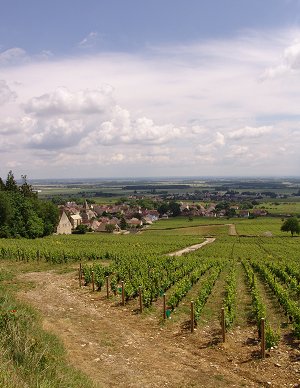
1996 René Engel, Vosne-Romanée![]()
Medium ruby-red. The nose right from opening is a bit of a star. Deep with a twist of oak before transparent red berry and redcurrant notes come through. Plenty of higher, slightly volatile notes too – but always quite compelling. The palate is just a little more challenging – very forward acidity, indeed borderline ‘too much acidity’, very, very linear presentation, still a little astringent tannin remains, but there’s also some bitterness in the finish. No sign of decline because this is exactly how the wine presented itself for the whole 3 hours before it was gone. A bit of a challenge this bottle, balanced by the lovely aromatics.
Rebuy – Maybe
spring 2007 issue is out
Here you can find the index page for the Spring 2007 Burgundy-Report. It’s easily the biggest issue yet, but as normal for the first issue of the year, the content goes wide, rather than deep.
I will answer such comments as I can until Saturday morning – then I will disappear for a well-earned (for my wife at least – i.e. no laptop!) one week rest.
Thanks, Bill
what’s next(?)
Very little time to add things here this week as I’m finalising the Spring Burgundy Report. The deadline (tomorrow) is immovable as I will go on holiday (Saturday) so the site will in ‘stasis’ for a whole week. But I look forward to responding to your observations on my return.
Once back it will be time to start working on this diary page – despite my efforts to-date, I find it far too ‘generic bloggy’ so will see what can be modified – note that nobody ever promised improvement! 😉
Ciao for now
investing in wine?
Today at Decanter.com http://www.decanter.com/specials/104729.html
Before I make any complaints let us be clear: there is a lot of useful/good advice in “Decanter’s wine investment guide in association with Berry Bros. & Rudd” Now I’ve said that let me take one excerpt from this ‘advice’:
Investment grade wine is also an improving asset. As fine wines mature they become more desirable and therefore more valuable. At the same time, as the wine ages and comes into its drinking window, it begins to be consumed making it even more rare, which in turn adds yet more upward pressure on prices.
I suppose that on the positive side, it’s unlikely that those that cannot afford it will lose in this type of investment. In recent years the investment bubbles have been popping all around us, yet here we find sage advice on why we should invest in a product(s) that is trading at an all-time high and where entry prices of the latest vintages are already cutting off an old (drinking) clientelle. It sounds like another bubble – and I’m not talking Champagne!
Few and far between are the people that annually have access to case quantities of Domaine de la Romanée-Conti, Petrus, Le Pin, de Vogüé etc. – and they don’t need the money – perhaps ‘investors’ might be offered timeshares in a case? Given the non-availability of these ‘blue chip’ cases what will you actually be allowed to invest in then? Overpriced Figeac or overvalued Vosne?
The only way to get a positive return is if you invest in a cellar with your intended return being years of drinking pleasure. If some of your well-chosen bottles appreciate in value – lucky them, lucky you!
On a last note, let us consider one of the cornerstones of investment – impartial advice. Who here is providing the advice for us? A wine magazine and a merchant – I guess there are parallels to brokers – they make money if the prices go up or down! Though on reflection, perhaps I should have bought that case of 1999 Romanée-Conti from Berry Bros a few years back – it was only £25,000…
96 hospices, corton charlotte dumay

A wine to separate the men from the boys! Joking aside I think you have to be that curious ‘burgaholic’ breed to take enjoyment from a wine like this – the ‘unconverted’ will simply screw up their faces and cry!
1996 Hospices de Beaune, Corton Charlotte Dumay![]()
Classic 1996 Corton. The nose is of blood and iron, eventually red berry fruit from the partially drained glass. The palate is linear and intense – almost metallic acidity pushes you into a quite long finish. The only thing that this wine gives away is the free polish of your teeth. I wouldn’t go as far as to say it’s enjoyable right now – but I was (just about) up to the challenge!
Rebuy – Yes
hemingway, kirschtorte and cuckoo clocks
A sunny day out in the country yesterday – German Blackforest country. Of-course Schwarzwalder Kirschtorte (Blackforest Gateau) was eaten (merely okay) and many cuckoo clocks were seen. To the left is the ex-largest cuckoo clock in the world – well in Schonach Germany anyway. The cuckoo weighs in at 20 kilos – but as you will note from the photo, we just missed it! Next onto Triberg with Germany’s highest waterfall – unfortunately the paths were closed off for saftey reasons – but for some unknown reason. I could only take a picture of the lower part of the falls and a plaque to Ernest Hemingway who (it says) visited in 1922.
the result – musigny, richebourg or chambertin
And the winner is – the one and only Mr Tom Blach !
Bouchard’s Chambertin today only has an average vine age of 25 years – I’m not sure about in 1998.
The vines are on the Chambertin, Latricières-Chambertin border and on average there are much less than the 100 cases I initially mentioned – closer to 60 cases from a tiny 0.15 hectare plot – so 2 barrels.
Now if I were to look at winesearcher:
That’s a difficult value proposition! Oh, and that’s before you even think of comparing to 2005 prices!
musigny, richebourg or chambertin? #3
So, the last piece of the jigsaw – everything should be easy now.
Wine #3
The first 20 minutes:
The first few sniffs disappoint, a little undergrowth but little else. Slowly a dense red note builds at the core with a slightly herbal, menthol note above. The palate is dense, plush and very well textured – contrasting to the minerality of wine 2. The tannins come through on the mid-palate onwards and finish slightly bitter but there’s a real creamy base and this is probably the longest finishing.
After 45 minutes:
The nose is good but not great, some extra width of high-toned fruit and occasional glimpses of coffee – the herbal element is now much more in the background. The palate remains dense, plenty of silky tannin and exquisitely long if not particularly involving.
90 minutes on:
The nose was almost coming together, but then a little cedar thing started to develop. The palate stays unmoveable; concentrated, perhaps a little dense and very long. Side-by-side with wine 2 this denser, but #2 is more mineral and fresh.
Wines two and three are easily the best of this trio as they show greater length and more importantly sophistication. I would not rebuy #1. Today I would rate #2 above #3 – for it’s wonderful aromatics – for the longer term I’m happy to keep checking back every 5 years or-so and even add to their number in my cellar – if I had both the cash and the opportunity.
Faces put to the names on Friday!
musigny, richebourg or chambertin? #2
Wine #2 – now we’re talking!
The first 20 minutes:
Deeper colour, a core of garnet with a ruby rim. The nose is very deep, and quite reduced. A fresh palate with laser-like intensity – this is excellent – plenty of velvetty tannin and certainly longer than wine #1, though that length (like wine 1) is quite oak based and initially slightly bitter. The fruit needs five minutes to provide a nice sweet black impression, still quite primary, but it starts to come through on the finish too – with just an edge of creaminess.
After 45 minutes:
The nose is now much fresher with higher-toned jellied fruit – almost confiture – creamy black-skinned fruit forms its base – this is now lovely. It’s softer on the palate now, which is becoming fuller – still, there are plenty of tannins bathing the mid-palate and finish but they seem quite round.
90 minutes on:
The nose continues to really impress, the higher tones have become ever redder though the base remains black and creamy. It’s the palate that remains the most unformed, but it’s concentrated, still rather linear and certainly very young. The last bottles should wait a minimum of five years in the cellar, probably much longer – but they will be excellent.